interfaith

chris
8128 ashes on table and in bowl cross of palms len

Lent

By Anthony MacIsaac 

Austerity is a marker of most religious life in some fashion. Sometimes it is part and parcel of penance, making up for one’s faults or sins. Sometimes it simply delineates pilgrimage, a journey towards God, a turning towards God. Perhaps it is best seen in the light of commitment in faith, a sign of character. By adopting the austere, in lieu of easier expressions of faith, people may show the extent of their conviction. 

Religious austerity expresses itself in various specific ways. Fasting from food and drink might be integral to it, in certain contexts. In other contexts, a period of poverty, without access to the luxuries of modern life, might be more descriptive. Celibacy – temporary or lifelong – may even become a factor. Monastic life is perhaps one of the best examples of a life dedicated to God, in the extremities of austerity. This is witnessed equally among the Buddhists of Tibet and elsewhere, and those Orthodox and Catholic Monasteries dotted across Europe. Pluscarden Abbey remains an example in our own Scotland. 

We further find that the austere is marked out in certain seasons, across the world religions. In Islam we have Ramadan, which incorporates strict fasting and a renewed sense of prayer. Such commitment often wins the admiration of people the world over. In Christianity, the season of Lent provides a similar example. Fasting is likewise present, even if not always so intense as in Ramadan, and prayer is emphasised alongside good works. Penance is certainly a major aspect of the season, and as we have entered into its first week, perhaps this merits some further reflection. 

Looking at the world today, we may consider the value of penance, and indeed the value of some austerity in our own lives. Materialism surely cannot have the final word. Looking at Ukraine, and also at Afghanistan, we see people thrust into poverty and hardship. Often this brings out the best in them, as tragic as the circumstances are. Looking at climate change, we are reminded by the Earth herself that we must curb our consumption. Some simplicity might be essential for the future, if we are to have a future. Pope Francis called for Ash Wednesday to be a day of special fasting and prayer concerning the situation in the Ukraine. He has also called for similar days of fasting previously, for those tragedies and problems that continue to beset the world at large. Perhaps this is one of the greatest points which we can reflect on concerning this Lenten season: how does it bring us to that life in God that leavens the world around us? 

Lent Read More »

895e20cbf9cac5c3ddfb866a4eda2a22dd2000b9

Saving St Mungo’s Museum

by Sr Isabel Smyth SND

On 17th February Glasgow City Council announced its budget for the forthcoming year and plans for post-covid recovery. Included in that budget is the statement “ As well as confirming the funding to keep all local libraries open, it will also allocate more than £1 million to reopen community centres and public halls, and £650k to reopen the much-loved St Mungo’s Museum and Provand’s Lordship”  This feels like a victory for all those who campaigned tirelessly for the council to keep local libraries, museums and community centres open. Was this part of the budget the result of that campaigning, did Glasgow City Council listen to the voices of its citizens and realise how committed people were to their cultural and community centres, recognising the value they have in the ethos and development of a city.

St-Mungo_s-10-08-int_24_1464494251

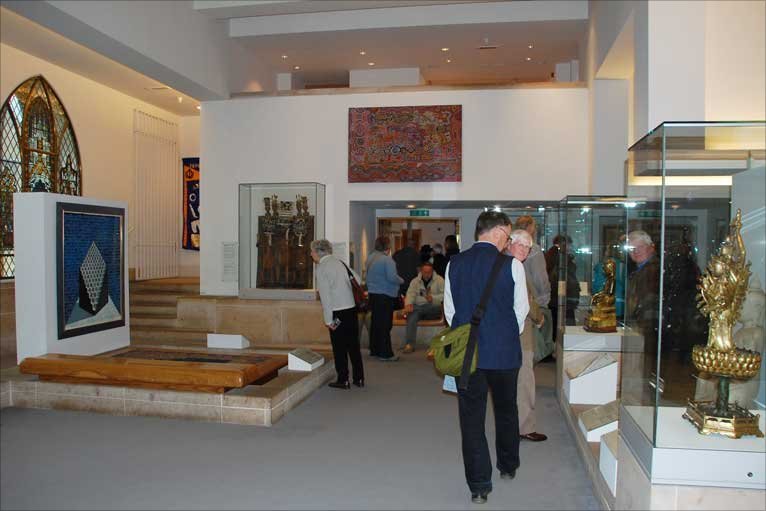
I was involved in the campaign to save St Mungo’s Museum or Religious Life and Art so that it would keep its interfaith and multifaith focus. Glasgow Life had indicated that its plan was to enter into an agreement with Historic Environment Scotland who own Glasgow Cathedral to revamp the Cathedral precinct to attract more visitors to the historic centre of Glasgow. This revamp would include St Mungo’s Museum and could mean a change in its focus to link more clearly with the history of the Cathedral. This has not yet been resolved but it is surely in keeping with the Christian origins of Glasgow to show its growth as the multifaith city, committed to social and interfaith harmony, that it has become.

The idea of a Museum of Religious Life and Art was the brainchild of Mark O’Neill, at that time Senior Curator of History with Gl. Museums. From the outset it was developed with a socially driven purpose, expressed in the mission statement:

to explore the importance of religion in people’s everyday lives across the world and across time, aiming to promote mutual understanding and respect between people of different faiths and none.  

Mark and his team were convinced that if the museum was to live up to this vision stakeholders would have to be consulted and included in the museum’s development – even in the decision to call it The St Mungo Museum of Religious Life and Art. The stakeholders were the various faith communities in Glasgow as well as the Glasgow Sharing of Faiths, the first and, at that time, only interfaith group in Scotland.  All these groups were approached and involved – donating artefacts and giving suggestions about the layout.  Once opened the museum became a centre for interfaith celebrations and dialogues and because of the involvement of faith communities from its inception the Museum felt very much like a home from home. It did indeed become a much loved venue and the thought of it closing was like a bereavement and loss of what was considered a safe and neutral space to conduct what were sometimes difficult dialogues.    

_48104034_interior2_bbc_766 (1)

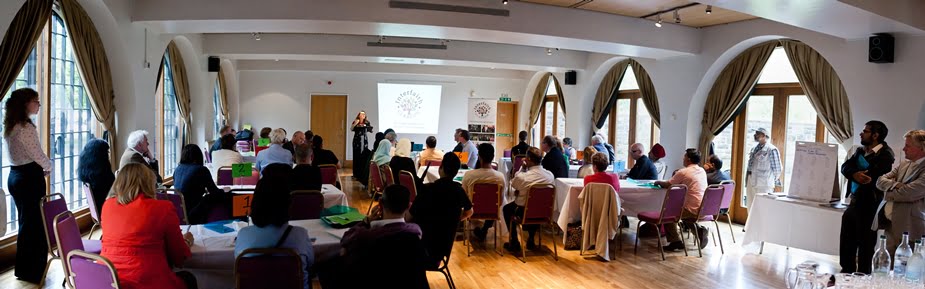
The Museum opened on 4th April 1993, one of only two Museums of Religion in Europe. Now there are more and many of those setting up similar museums came to Glasgow to learn from the St. Mungo experience. For these interfaith friends the thought of St Mungo’s closing or even changing its focus seemed incredible and many of them added their voices of protest to those of Glaswegians and the thousands of people who signed the petition instigated by Interfaith Glasgow. 

This is not the first time that there have been plans to close St Mungo’s Museum, nor the first time it has been saved. It’s as though Glasgow Council needs to be reminded from time to time of its significance and the important contribution it makes to good community relations. Hopefully that no matter what future developments there might be stakeholders from Glasgow’s diverse religious communities, interfaith organisations, and anti-sectarian organisations will be consulted.   


pan_shot_30

Saving St Mungo’s Museum Read More »

Eng22

On the 2nd Anniversary

A Guest Blog by Devin Watkins, Vatican News Agency

Pope Francis: ‘Embrace human fraternity to stop endless destruction’

Pope Francis released a video message to mark the 2nd International Day of Human Fraternity, and urges all people to trod the difficult path of fraternity in order to overcome the prejudices and conflicts that divide humanity.

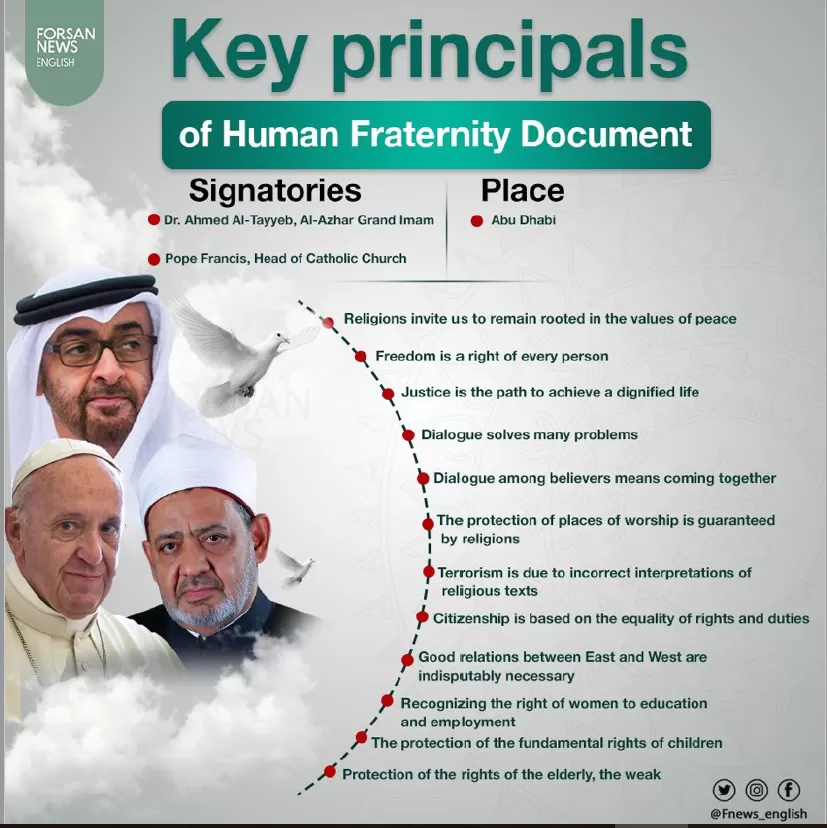
The International Day of Human Fraternity was set up by the UN General Assembly to commemorate the signing of the Document on Human Fraternity for World Peace and Living Together by Pope Francis and the Grand Imam of Al-Azhar, Ahmed Al-Tayyeb, in Abu Dhabi on 4 February 2019.

Pope Francis sent a video message on Friday as the world marked the second Day dedicated to this historic event. Fraternity, said the Pope, can act as a “bulwark against hatred, violence, and injustice”.

He thanked the many people and organizations—especially Sheikh Mohammed bin Zayed, Crown Prince of Abu Dhabi, and the Higher Committee for Human Fraternity—for the many initiatives which seek to implement the Document’s values.

“Fraternity is one of the fundamental and universal values that ought to undergird relationships between peoples, so that the suffering or disadvantaged do not feel excluded and forgotten, but accepted and supported as part of the one human family. We are brothers and sisters!”

Worshiping God, loving neighbour

Pope Francis said all people, regardless of religion or creed, are called to promote a “culture of peace” that welcomes all, while encouraging development and solidarity.

Throughout his message, the Pope repeated the affirmation that “we all live under the same heaven” and that we are all God’s children, no matter the colour of our skin or social class.

He said every person has a role to play in making the world a better place, by helping others raise “their eyes and prayers to heaven.”

“Let us raise our eyes to heaven, because whoever worships God with a sincere heart also loves his or her neighbour. Fraternity makes us open to the Father of all and enables us to see others as our brothers or sisters, to share life, to support one another and to love and come to know others.”

‘Unity in diversity’

As the world faces the Covid-19 pandemic, he said, we must remember that we are not saved alone. Rather, we must extend our hands “to celebrate our unity in diversity—unity, not uniformity,” said the Pope.

“The time of fraternity has arrived,” he added, so we should strive to “live in solidarity with one another.”

He also lamented the many little wars—a “third world war being fought piecemeal”—that destroy lives, force children to endure hunger, and suppress educational opportunities.

“Now is not a time for indifference: either we are brothers and sisters, or everything falls apart.”

We must not be indifferent to each other’s sufferings, said the Pope. The common heritage of Christians, Muslims, and Jews in God’s promise to Abraham joins us and helps us live “a fraternity as vast and bright as the stars of heaven.”

‘Anchor of salvation for humanity’

Pope Francis again greeted his “dear brother”, the Grand Imam, and acknowledged that the path of fraternity is “long and challenging” yet it is “the anchor of salvation for humanity.”

“Let us counter the many threatening signs, times of darkness and mindsets of conflict with the sign of fraternity that, in accepting others and respecting their identity, invites them to a shared journey,” he said.

Every person should be respected in their own identity and personality, added the Pope.

And he concluded by thanking everyone who believes that the world can live in harmony, since we are all “creatures of God: brothers and sisters.”

“I encourage everyone to be committed to the cause of peace and to respond concretely to the problems and needs of the least, the poor and the defenseless,” said Pope Francis. “Our resolve is to walk side by side, ‘brothers and sisters all’, in order to be effective artisans of peace and justice, in the harmony of differences and with respect for the identity of each.”


On the 2nd Anniversary Read More »

Golden Threads

Golden Threads

GOLDEN THREADS REAWAKENED

Weaving a Legacy

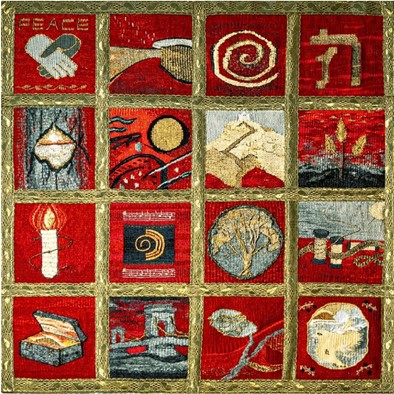
A group of amateur tapestry weavers in Edinburgh have together created this tapestry

 Background The tapestry uses golden threads collected by Hedwig Philip which had not seen the light of day for 70 years. Hedwig was a German Jew. She and her husband narrowly avoided the Holocaust. They left Berlin in 1941 and travelled to join family in Pennsylvania.

A skilled needlewoman, she collected golden threads and embroidered a Torah Mantle for the local synagogue. In 1951 she travelled with all her belongings to Britain to join her daughter in Newcastle. Hedwig died not long afterwards. Her box of golden threads remained unopened, passed down to her daughter and then to her granddaughter, Cathie Wright.

Golden Threads

Weaving the tapestry This group tapestry pays homage to Hedwig’s story, but the quantity and beauty of the threads, the heritage and the journey travelled, called for something more. The result is a modern, secular tapestry incorporating these historic golden threads. There are 16 panels, each one designed by the weaver, drawing on the themes of Jewish heritage, refugee travel and survival, conflict avoidance, building bridges and seeking a better world with hope for a brighter future.

As Cathie has said, ‘This is a community enterprise that takes the threads from one spiritual tradition to universal themes that celebrate life and survival’.

The tapestries are woven with contemporary materials (wools and cottons) supplementing the old golden threads. They are joined with an overlay of golden braid which also came from Hedwig’s box. The overall size of the composite tapestry is 30 inches square.

For more information please contact Project Leader Jackie Grant     jackieclairegrant@gmail.com

Photo © Geoff Gardner Photography

**********************

Supplementary information

A photo of Hedwig and the contents of her box not opened for 70 years

Hedwig

The Weavers and the Names of their Tapestries 

Anita Nolan

 Reconciliation

Sandra Carter

 Into the Light

Joan Mclellan

 Spiral

Sarah Clark

 Hedwig

Lindi McWilliam

 Breaking through Barriers

Judith Barton

 From the Ruins

Elspeth Hosie

 Journey’s End

Francesca McGrath

 From  the Darkness

Hilary Watkinson

Glimmer of Hope

Barbara Clarke

 Ode to Joy and Peace

Jackie Grant

 Tree of Life

Kirsteen Shaw

 Return to the Light

Irene McCombe

Trunk of New Beginnings

Serena Naismith

Linking Communities

Joan Houston

New Life Sycamore

Ann Smuga

Dove of Peace

Stitching and assembly of the composite tapestry by Sylvia Davidson

 Grateful thanks to Cathie Wright for giving us the threads and encouraging the project, and to professional tapestry artists Joanne Soroka and Jo McDonald for their invaluable advice and support.

Golden Threads Read More »

Jtj

Jesus the Jew

By Sr Isabel Smyth

This is the season of Advent, the season when Christians prepare for Christmas and reflect on the significance of Jesus for themselves and the world. During these four weeks Christians will be singing advent carols such as ‘O come, O come Emmanuel’ with lyrics that talk of “captive Israel, that mourns in lonely exile here. It calls on Jesus to “free thine own from Satan’s tyranny, from the depths of hell thy people save”. What would it be like to sing these words in the presence of Jews, how would they feel to hear themselves described as captive to Satan’s tyranny? Unfortunately, these words reflect Christianity’s attitude to Judaism over the centuries – Jews were seen as bound by a legalism that Christianity had been freed from, they were in the thrall of the devil because they had not accepted Jesus as their saviour, and this was because they were spiritually blind. Tragically this negative attitude led to violent and horrific anti-Semitism over the centuries. Jews were subject to pogroms, expulsion and violence, resulting in the murder of 6 million Jews in the Nazi death camps.

Thank goodness this attitude has changed and in the Catholic church there is a much more positive attitude towards the Jews and Judaism. One of the reasons for this change of heart has been the recognition that Jesus, his mother, his disciples were all Jews and that we Christians have a familial relationship with Judaism.

It’s sometimes difficult for Christians to truly take this on board but if we are to truly know Jesus, we must know something of his context. Jesus lived in Galilee, in what is now northern Israel. It was not a backwater. It was cosmopolitan, situated on the silk road route and people living there would have encountered other cultures and beliefs so that it is possible that Jesus spoke Aramaic, Hebrew, Greek and Latin. The country was under Roman rule and the Jewish people longed for liberation. They looked forward to someone, a messiah, who would bring this about. Jesus is likely to have engaged in discussions and debates with other Jews, including Pharisees, as to how and when this might happen as he would have debated how best to live a good Jewish life. And he did all this as a faithful Jew. Jesus was born, lived and died a Jew. He never rejected or denied his religion though Christians have so underlined the importance of Jesus’ divinity and uniqueness that they have misunderstood the gospels and interpreted them as Jesus, and even God rejecting Judaism.

This is not accurate. Jesus loved his faith and lived it faithfully. He loved the Torah, which is the spiritual guidance at the heart of Judaism. In Matthew’s gospel Jesus tells his disciples that he had come, not to abolish the law, but to fulfil it. At the time there was a lot of debate among the various groups and teachers about what it meant to be a good Jew and how to keep the Law in an occupied land. Questions, such as was it lawful for a Jew to pay taxes, were not a challenge to his authority or an attempt to undermine him but the kind of dilemma facing Jews at that time.

Jesus kept the law, he ate kosher food, he was circumcised like all Jewish boys, he went to the Temple in Jerusalem, he attended the synagogue, he read the Jewish scriptures and would have prayed and even sung the psalms. He would have prayed three times a day wearing phylacteries, he would have worn fringes on his outer cloak.

He kept the Sabbath. There is an incident in the gospels when Jesus’ disciples plucked corn on the Sabbath because they were hungry and when Jesus was challenged about this he said, “the Sabbath is made for man not man for the Sabbath”. Some biblical commentaries suggest that this is a sign that in Jesus the age of keeping the law had been replaced by the age of redemption. But Jesus was not encouraging a breaking of the law because we now know that such an approach was not unknown in the Jewish tradition and that the law was to enhance life. What Jesus was doing was offering one interpretation of the law.

We know that Jesus had a deeply personal relationship with his father, calling God Abba. This is often, maybe even always, interpreted as Jesus having a more intimate and personal relationship with God than the Jews of the time who would always address God in more formal terms. This is not so – there are many examples of Jews talking to God as Abba and once again Christians have tried to make Jesus more unique than he was.

What Jesus is doing in the gospels is teaching his disciples how to be good Jews, how to live by the spirit of the law and respond from the heart. It was one way of being Jewish among others. Often conflicts in the gospels are not reflecting the time of Jesus but the times when the gospels were written and reflect tensions between the synagogue and the growing Christian community, not between Jesus and his contemporaries, including the pharisees.

Christians are followers of Jesus and live according to his understanding of faith and religion but how tragic if in doing this we interpret the scriptures in anti-Jewish ways and fail to respect the religion that Jesus loved and honour a people that Pope John Paul II described as our elder brothers and sisters in faith.

Jesus the Jew Read More »

Cop26Vigil

Cop 26

By Sr Isabel Smyth SND

COP 26 has started, and thousands of people have landed on Glasgow. Today is the day for world leaders and significant individuals to address the conference. Listening to them they all seem to be singing from the same hymn sheet. Environmentalists and young people from developing countries face the conference participants with the reality of climate change and its consequence for the world and their generation with strong, honest and challenging words. ‘You do not need to see my tears or pain to know what is at stake’, said one of them. Thousands of protesters have proved their commitment by walking in pilgrimage to Glasgow, demonstrating across the River Clyde from the conference venue to remind negotiators of what is at stake and how the world is depending on them for a just and constructive agreement.  A lot of their concerns and hopes for the future were echoed by the world leaders themselves. There is no need to doubt that presidents and prime ministers are unaware of the urgency of the climate crisis, of the greed and selfishness that needs to be challenged, of the solution that is in their hands. But will the worlds translate into action? – that’s the rub.

In ‘The Home We Build TogetherLord Jonathan Sacks maintained that people will only work together for the common good if they are faced with the same problem, a problem that requires cooperation for a solution. Now we have such a problem. It’s hard to think of any other issue that affects every human being, rich or poor and, beyond humanity, all sentient beings, and the very planet itself. We are in danger of making this beautiful blue planet of ours inhospitable and uninhabitable. And many of us know it and feel the pain of it.

This was very obvious yesterday at an interfaith vigil to pray for the success of this COP. It was simple and showed a great unity of purpose. It began with the reading of what has come to be known as the Glasgow Multifaith Declaration by a Catholic and Episcopalian Bishop, an Imam and a representative from the Sikh faith. The declaration follows on from the 2015 interfaith Lambeth Declaration and the Scottish Religious Leaders’ Forum’s Statement of Commitment of 2020. It has been signed by religious leaders in Scotland and the UK and acknowledges the unity among faith communities ‘in caring for human life and the natural world’ and how people of faith ‘share a belief in a hopeful future, as well as an obligation to be responsible in caring for our common home, the Earth’. It includes the commitment to reflect deeply in prayer and meditation to discern how to care for the earth and one other, to make transformational change personally and communally through individual and collective action and to be advocates for justice for the earth and the poor who suffer most from climate change.

The other element in the vigil was a prayer for the environment from each of nine faiths – Christian, Buddhist, Jewish, Brahma Kumari, Sikh, Hindu, Baha’i, Pagan and Muslim. What struck so many of the attendees was how similar the sentiments of the prayer were even if expressed differently. For some people new to interfaith this was a revelation but others like me, who have been involved for some time, know there is a unity among people of faith and some of us feel closer to people of other faiths than we do to people in our own. One of the joys for me was to meet friends whom I have known and worked with over the years but have not seen for some time. One of them mentioned that it was her visit to the International Flat in Glasgow and meeting Stella Reekie that started her on her interfaith journey, which is my story too. Stella began the first interfaith group in Scotland, and I consider her the pioneer of interfaith in Scotland which now has a national interfaith body and twenty local interfaith groups. My friend said, ‘you can feel her presence here’ and so you could.

It is wonderful to know so many people who share a love and concern for the planet and it can be easy to forget that others might feel differently. Some people have too many survival concerns to be thinking of climate change, others are just not interested and don’t recognise the problem, but others are quite cynical about conferences such as COP. This is COP 26 – why, if the other COPS did not produce a result, will this one?  Climate change has always been with us, human beings will eventually become extinct just as the dinosaurs did, how can politicians speak about climate change and fly all over the world to these meetings, the suggestion for combatting climate change are just not possible – all arguments put to me in a recent conversation. There’s no answering these statements. A desire to care for our planet cannot be developed through argument, I suspect, but only by a new vision that appreciates the interconnectedness of all life and our place in the great story of the universe – a story that we don’t hear enough of but one which might help us see with new eyes.  

Cop 26 Read More »

FAITHINVEST3

Have you heard of Faith Plans for People and Planet?

A blog on Faith-based investing, by Yolanda Matro, Committee Member

Recently I was invited to attend a Zoom meeting by a friend actively involved in Faith Invest.  Their latest project, in conjunction with the World Wide Fund for Nature, is the Faith Plans for People and Planet. Faith Invest’s main role will be to encourage faiths to embed into their plans investment policies which are consistent with their faith while the WWF will provide expertise on key environmental issues.

I was attracted immediately by the words ‘Faith Plans’!  And so, I registered and was amazed by the number people present. They were mostly communication officers from many parts of the world and from various religions who have expressed their interest in this project.

I learned how the 4th of October this year proved to be a significant day for the environment. On that day Pope Francis along with leaders of world religions made a public declaration pledging their organisations to actively address the climate crisis. Later that same day, Faith Invest announced their ‘Faith Plans for Planet and People’ project. The timing of both announcements is critically important. They came just before the start of the UN’s COP26 Climate Conference which will be held in Glasgow from 31st October to 12 November 2021. This is a crucially important COP if the effective shredding of the Paris Climate Agreement is to be prevented.

I also learnt more about Faith Invest. It is an international non-profit organisation. Its ‘Faith Plans for People and Planet’ drew inspiration from the 2009 Faith Commitments programme in which more than 60 traditions from all major faiths – including Buddhism, Daoism, Christianity, Hinduism, Islam, Judaism, Sikhism and Shintoism – made long-term commitments to the environment. Each group produced a plan relevant to their own beliefs, teachings, and practices. The response made by these groups to environmental issues over the coming decade was profoundly influenced by the success of their plans.

The new initiative for Faith Plans wants to build on the success of the original 2009 Faith Commitments programme by encouraging not 60 groups to make plans but thousands to become involved. ‘Faith Plans for People and Planet’ is a massive project which aims to get all faiths to set out clear plans on how they will reach environmental sustainability over the next decade. The plans are to be a response to the triple crises of climate change, ecological devastation, and the impact of Covid-19 on national commitments around the Sustainable Development Goals.

Seven key areas have been identified in which the world religions can have a significant impact on environmental action through their resources and traditions. These key areas are:

  Faith-consistent use of assets

  1. Education and young people
  2. Wisdom
  3. Lifestyle
  4. Media, advocacy & outreach
  5. Partnerships, eco-twinning
  6. Celebration

The CEO of Faith Invest, Martin Palmer, concluded the meeting by saying that it is important to connect with one’s Deity, with oneself, with others and with creation. In other words, examine our fundamental relationships. It left me feeling that if we put love in all these relationships, everything will work for the good of creation.    

For more information, please visit www.faithplans.org.                                                            

Yolanda Matro   18th October 2021

Have you heard of Faith Plans for People and Planet? Read More »

Screenshot 2021 09 08 at 20.08.05

Common Ground in Dialogue

A Blog Post by Sr Isabel Smyth, Secretary of the Bishops’ Committee for Interreligious Dialogue

Last week I was introduced to the work of Dr Peter Admirand who is the Director of the Centre for Interreligious Dialogue at Dublin City University. Dr Admirand was the keynote speaker at a colloquium on ‘Interreligious Dialogue in the Time of Pope Francis, organised by the Scottish Bishops’ Committee for interreligious Dialogue.

While acknowledging the change and development in the Catholic church’s attitude to interreligious dialogue and the strong bond of friendship between the Pope and Rabbi Skorka, Dr Admirand widened our understanding of dialogue to include not just believers but also those who, as atheists, do not believe in God.

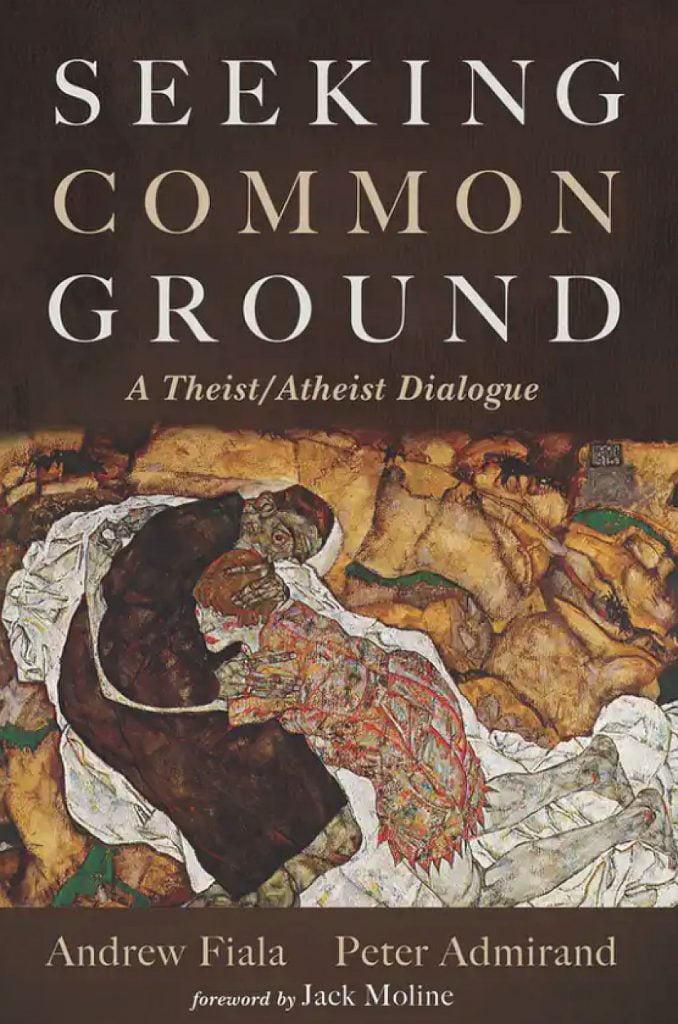
Dr Admirand’s most recent book is an account of such a dialogue, his own with Dr Andrew Fiala, the Professor of Philosophy and the Director of the Ethics Centre at California State University, someone who has an interest in religion but is a declared atheist. The dialogue contained in their book Seeking Common Ground: An Atheist-Theist Dialogue is refreshing in that, like so many of these kinds of dialogues, it is not polemical with one side or the other trying to prove or disprove the existence of God.  Rather it focuses on the common ground of a set of virtues which allows for an honest conversation and a common search for understanding without suspicion and resentment. 

 Having learned something of the faith journey of each of the writers, the rest of the chapters focus on a virtue, suggested by one of the writers and then responded to by the other. There are seven virtues in all – harmony, courage, humility, curiosity, honesty, compassion and honour.  While the writers explore each virtue from their own perspective there is a learning for all of us in considering their role in interfaith relations.  Some, it would seem to me,  refer to the attitudes necessary for dialogue – a desire for harmony so that we are willing to set aside, at least for the time of dialogue, judgements and prejudices; a humility in listening to the truth as another sees it while recognising and acknowledging the terrible consequences of the failings of religions and ideologies; a compassion that recognises our shared humanity in its seeking for truth, even if we come up with different answers; an honour that  respects and values the integrity of the other and an honesty that allows us to see how others might interpret and understand our words and actions. Recently Pope Francis, a great advocate of dialogue, found himself challenged when he suggested that the Torah does not offer fulfilment but is in fact a journey that leads to an encounter with Christ, seemingly undoing advances in Catholic – Jewish relations from the days when Christianity was thought to supersede Judaism and render it irrelevant.  Now the Vatican is having to clarify that the Pope was speaking within the context of Christian scripture and stating “the abiding Christian conviction is that Jesus Christ is the new way of salvation. However, this does not mean that the Torah is diminished or no longer recognized as the ‘way of salvation for Jews.”

When such a thing happens to a Pope it is newsworthy, but such misunderstandings can happen in dialogue to all of us though if the dialogue is based on friendship, as is the case with the Pope’s relationship with the Jewish community, the upset can be talked about openly and be a moment of learning for everyone.  But it is fear of such incidents that can keep some people from engaging in dialogue. Courage is then needed to break out of our sense of self-sufficiency and comfort and enter the world of another. For those of us who have done it, the journey is transformative and enriching but taking the first step can be difficult. Perhaps it is at that point that curiosity is something to be valued as a motivation for setting out on what is truly an adventure.

At our colloquium Dr Admirand highlighted curiosity as the value he hesitated over and some attending the event agreed with him. He noted that the Catholic tradition, based as it is on the certainty of Revelation, was suspicious of curiosity believing that it could undermine religious belief and, in their book, Dr Fiala states his belief that progression in science, psychology and other disciplines has done just that, especially since the Enlightenment.  It certainly has taken many people beyond what Fiala calls naïve religion and that surely must be a good thing. There is of course a dangerous curiosity and today we are aware of the dangers of the internet, experimentation with drugs and other substances for example that can lead young people to play with fire – metaphorically if not literally. Pope Francis has warned against idle curiosity that is empty and superficial, but he has also said “the secret to joy: never suppress positive curiosity; get involved, because life is meant to be lived”.

Within the context of interreligious dialogue curiosity is surely a value which, if strong enough, gives us the courage to enter into the world of others and come back to our own changed and enlightened not just about the other but also about ourselves, our beliefs and the world we inhabit.

Common Ground in Dialogue Read More »

Rosh Hashana, Jewish New Year Holiday, honey, apple, pomegranate, hala

Rosh Hashanah: In the Presence of the King

Guest Blog by Rabba Dr. Lindsey Taylor-Guthartz

Lindsey-Taylor-Guthartz-a
Rabba Dr. Lindsey Taylor-Guthartz

Rosh Hashanah, the Jewish New Year, starts in the evening of 6 September this year, and lasts till the evening of 8 September. It ushers in the Ten ‘Days of Awe’, which continue until the end of Yom Kippur, the Day of Atonement, and constitute the high point of the Jewish year. They are a time of reflection, of soul-searching, and repentance, when even the least observant Jews try to get to synagogue for part of the long, elaborate services with their evocative music and solemn atmosphere.

Rosh Hashanah itself marks ‘the birthday of the world’, the anniversary of Creation (whether understood literally or metaphorically), and is thus a universal festival that celebrates God’s absolute sovereignty and power. The liturgy for the day speaks of God as Monarch, and imagines the Jewish people standing in the heavenly court, paying homage to God and enacting a ‘coronation’, with our prayers serving as a crown. Though the services are lengthy and intricate (a traditional Rosh Hashanah morning service can take five hours!), the magnificence of the mediaeval poem-prayers and the special melodies that are only sung at this time of year combine to create a sense of awe and solemn celebration, culminating in the piercing call of the shofar, the ram’s horn that is blown as part of the service. Its raucous shriek summons us to repentance, to consciousness of the urgency of the day, and simultaneously recalls Abraham’s near-sacrifice of Isaac, cancelled at the last moment by God’s mercy, and replaced by a ram.

At the other end of the Days of Awe stands Yom Kippur. Though closely linked to Rosh Hashanah, it is also its exact opposite: where Rosh Hashanah is universal and combines solemn joy and awe, Yom Kippur is intensely individual: each person stands alone in front of God, and tries to repair their relationship with the divine, conscious of their failings. Where Rosh Hashanah includes festive meals, starting off with apples and honey to express our wishes for a sweet new year, Yom Kippur is a 25-hour fast, freeing us to focus on the most intense and important aspects of our lives. Together, Rosh Hashanah and Yom Kippur mark the twin poles of our spiritual lives—God and our individual souls—tying them together in love, majesty, and intimacy.

With thanks to CCJ – https://ccj.org.uk/blog/RoshHashanah 

Rosh Hashanah: In the Presence of the King Read More »

Guido Reni St Joseph with the Infant Jesus WGA19304

The Father in Abrahamic Religions

By Anthony MacIsaac

Inter-religious dialogue has often touched upon the topic of Motherhood, and there has been a wealth of reflection on this, even unto the apparently radical idea of God as Mother. Not so often, it would seem, has Fatherhood been discussed in this way. In this “Year of St. Joseph” – inaugurated by Pope Francis, and ending this December – it seems pertinent to consider what Fatherhood means more deeply. 

To begin with St. Joseph himself, Christianity generally considers him the “Foster-Father” of Jesus Christ. In a certain sense of analogy, the Holy Family resembles the Holy Trinity. Jesus Christ as the Son, Mary as the Holy Spirit, St. Joseph as the Father. Alike to the Father – St. Joseph remains in the background, and is an unseen presence. His position within Christian piety has fluctuated. In the medieval period, he was often seen even as a cantankerous nuisance – caricatured as such in the carnival performances, which sought to emulate the key elements of Christ’s life, usually on Shrove Tuesday. It is difficult to say how this unfortunate image grew, but it seems to have been culturally rooted in the time. Many may have considered him an unequal spouse to the Virgin Mary, and the role of step-father may have been thought of in negative terms. Yet, it could be that the humour regarding St. Joseph was in good natured spirits too. Whatever the case, his cult soon grew, especially with his role as Patron of the “Good Death”. Since he disappears from the Gospel early on, he is considered to have died during Jesus’ teenage years. By the 19th century, he was seen as “The Worker”, and a Patron to labourers everywhere. His popularity continued to increase, and in the 20th century his role began to emerge anew as a Father-figure. He was invoked in particular as a Saint of family life. With the “Year of St. Joseph”, his status might be at its apogee, and it would seem the Catholic Church is calling her members to a greater consideration of this holy man. In short, his role as a Father-figure carries with it many connotations. Even if he wasn’t perfect, his hard work as a carpenter and his devotion to Mary provided a safe and secure environment for Jesus to grow. Himself taking on the carpentry that St. Joseph no doubt taught Him, Jesus became a man probably quite like St. Joseph, doubtless also in His tenderness and care for those around Him. It is also notable that the Jews of this time saw Jesus as the son of Joseph, to the extent that the genealogy of Jesus refers back to King David via him – even if Mary’s genealogy is actually used in one of the Gospels. 

 The place of the father within Islam has certain similarities to that of St. Joseph within Christianity. When the Prophet Muhammad’s mother Aminah fell pregnant, her husband Abdullah left for a trading trip. Tragically, during his time away he fell seriously ill, and died without ever meeting his son. The aged figure of Abd al-Muttalib, the father of Abdullah, then took Muhammad under his protection. Despite being Muhammad’s grandfather, Abd al-Muttalib raised the boy as his own son, and exerted a formative role in the boy’s growth. His place within the Islamic tradition is interesting, in that his earlier life is characterised by an adherence to the “old ways” of monotheism, before the coming of Islam. One episode in particular is striking, in that Abd al-Muttalib almost sacrifices his son Abdullah, alike to Abraham and Ishmael – in Islam it is Ishmael and not Isaac who occupied this place. The familial descent of Muhammad from Ishmael comes through the line of Abd al-Muttalib, whose own great-grandfather was Qusai, the King of Mecca. The parallels with Jesus’ descent from the King of Israel, David, and the preceding Patriarchs are clear. Dying when Muhammad was eight years old, one of Abd al-Muttalib’s other sons took on the role of foster-father to Muhammad, Abu Talib. The relationship between Abu Talib and his nephew was always one of warmth, but there is controversy as to whether he accepted Muhammad’s claims to prophecy – and he thereby remains a difficult figure in Muslim tradition. In any case, he helped his nephew secure his place within the Meccan community. Over time Muhammad himself became a father, and many Muslims today trace their ancestry back to his grandsons Hassan and Hussein. There are certain Sufi litanies that invoke these individuals, in prayer to God, and these reflect a veneration for Muhammad as father to the Ummah (Nation).

In Judaism, certain figures are likewise considered as fathers to the Chosen People. Abraham – venerated as “Father in Faith” by Jews, Christians and Muslims – represents the first among these, leaving asides the legendary Noah for now. Recently Pope Francis visited Abraham’s place of birth – the ancient city of Ur, in Iraq. This choice was made because of the unifying significance to the life of Abraham, whose role as father is key to God’s Covenant with him, that promises descendants as numerous as the stars. God even introduces Himself to Moses as the God “of Abraham, of Isaac and of Jacob”. With Jacob’s twelve sons, the twelve Tribes of Israel are evoked – and the Nation of Israel proper takes its foundation from these twelve Tribes. To take a brief glance back at Noah, his position as proverbial father of Humanity has also been used somewhat within Jewish apologetics to underscore the reality that we are all called to some share in God’s plan. There is much more that could be said here; however it seems good to highlight the role of fatherhood within mainstream Abrahamic religion as a creative, nurturing and guiding presence.

(Our Feature Image is Saint Joseph with the Infant Jesus by Guido Renic. 1635)

The Father in Abrahamic Religions Read More »

Scroll to Top